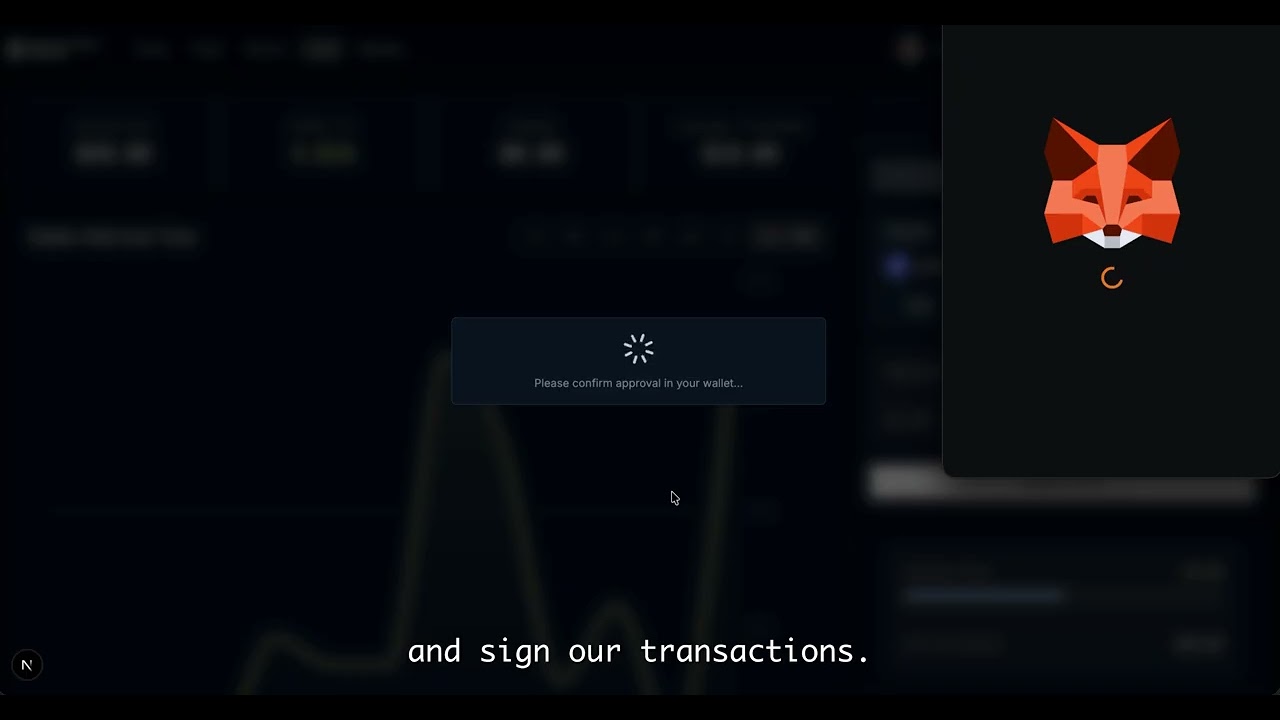
Prediction markets have grown into a multi-billion dollar ecosystem, yet the capital locked in positions remains fundamentally illiquid. Traders who hold strong convictions are forced to choose between maintaining their exposure and accessing the capital they need. Varla changes this. It’s a lending infrastructure built from scratch for prediction markets — deposit your positions as collateral, borrow stablecoins, and keep your exposure intact.
The Problem
Today, if you hold a position on Polymarket or Opinion, your capital is locked until the market resolves. There’s no way to borrow against your positions, no way to use them as collateral, and no way to unlock liquidity without selling.
Consider a concrete scenario. You hold $50,000 in YES positions across several Polymarket markets — elections, macro events, crypto outcomes. Some resolve in weeks, others in months. You’re confident in your positions and don’t want to sell. But you need capital: maybe to take a new position, cover an expense, or simply redeploy into a higher- conviction trade.
Your only option is to sell. Closing a position means eating the spread, giving up your exposure, and paying fees to re-enter later if your thesis hasn’t changed. The capital is there — it’s just frozen.
This isn’t a niche problem. Across Polymarket alone, hundreds of millions sit in open positions at any given time. Multiply that across Opinion, Kalshi, and the next wave of conditional token platforms, and you’re looking at billions in idle capital with no way to make it productive.
Why Traditional DeFi Lending Doesn’t Work Here
The instinct might be to plug prediction market tokens into an existing lending protocol — Aave, Compound, Morpho. But these systems are designed for fundamentally different collateral.
Traditional DeFi collateral (ETH, stablecoins, LSTs) has continuous price feeds from deep, liquid markets. It doesn’t expire. Its value moves gradually enough that liquidation bots have time to react. The entire risk model assumes smooth, continuous price curves.
Prediction market positions break every one of these assumptions:
Bounded outcomes. A conditional token resolves to exactly 0 or 1. There’s no middle ground. A position trading at $0.85 today will be worth either $1.00 or $0.00 when the market settles — the kind of discontinuous price jump that traditional liquidation systems aren’t built to handle.
Known resolution dates. Every prediction market has a settlement date. As that date approaches, the risk profile of the collateral changes dramatically. A position with six months to resolution is fundamentally different from one resolving next week, even if both trade at the same price today.
Thin order books. Prediction markets don’t have the deep, continuous liquidity of ETH/USDC. Price feeds can be stale. A single large order can move the market. Oracle manipulation is a real concern in markets where total liquidity might be measured in hundreds of thousands rather than hundreds of millions.
Binary collapse risk. When new information arrives — a court ruling, an election result, a policy announcement — a prediction market can reprice from $0.80 to $0.10 in minutes. Traditional lending protocols assume collateral declines gradually enough for orderly liquidation. Prediction markets don’t offer that luxury.
These aren’t edge cases. They’re the defining properties of prediction market collateral. Lending against it requires infrastructure that treats these properties as first principles, not afterthoughts.
How Varla Works
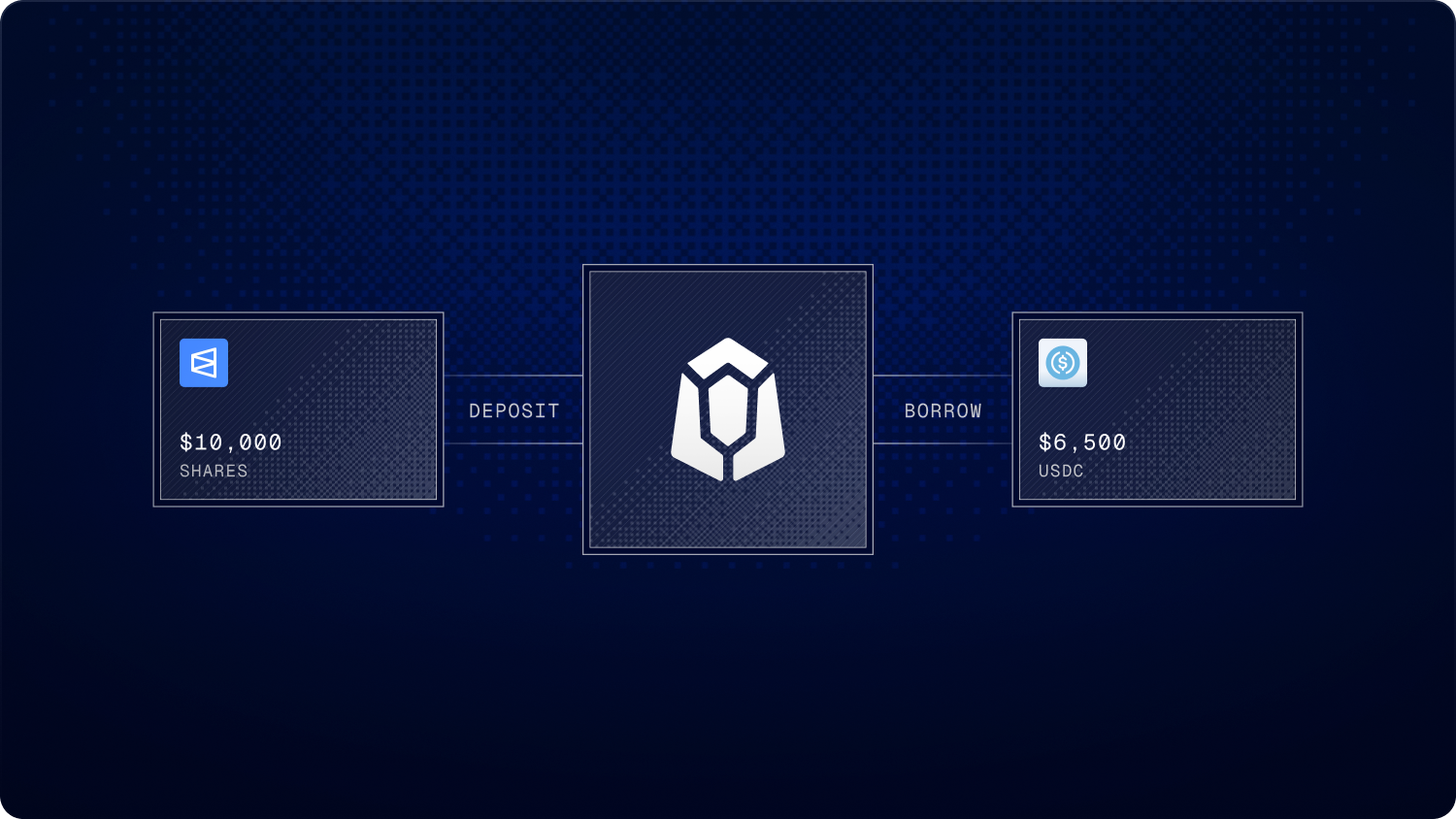
Varla is a lending protocol built from the ground up for prediction markets. The core model is straightforward: deposit prediction market positions as collateral, borrow stablecoins against your combined portfolio, and repay when you’re ready.
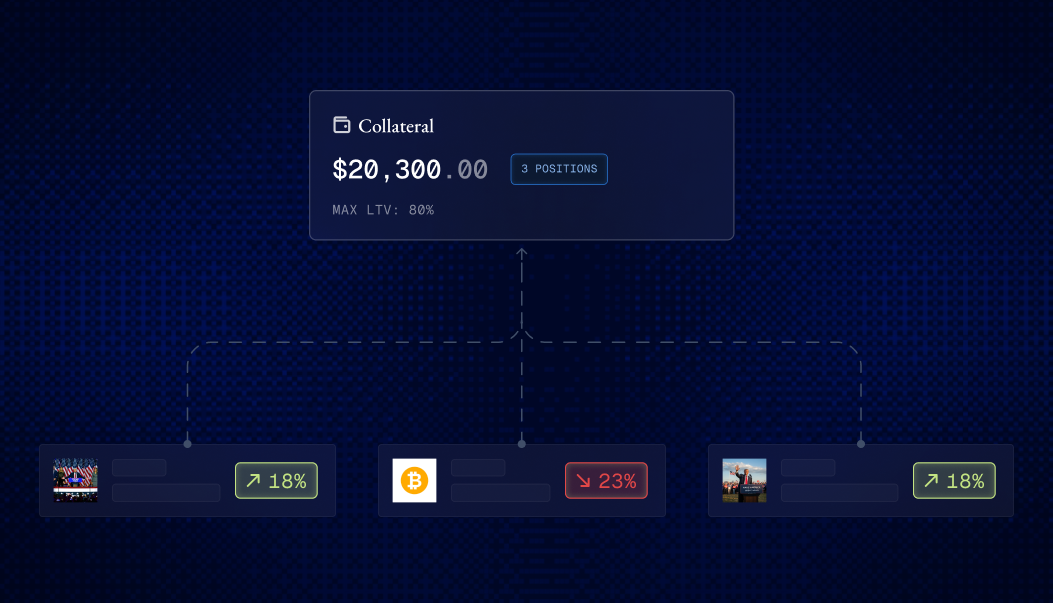
Cross-margin accounts. Unlike protocols that silo each collateral type, Varla manages a single cross-margin account per user. All of your deposited positions — across different markets, different outcomes, different platforms — contribute to one combined health factor. This means your well-performing positions help support your riskier ones, reducing the chance of liquidation and maximizing your borrowing capacity.
The lending flow. A user opens an account, deposits one or more prediction market positions as collateral, and borrows USDC from the protocol’s lending vault. Interest accrues continuously on the debt. At any point, the user can supply additional collateral, repay part or all of their debt, or withdraw excess collateral — as long as the account’s health factor stays above 1.0.
Stablecoin vault. Liquidity providers deposit USDC into Varla’s vault and earn yield from borrower interest payments. LPs earn unconditionally — their yield doesn’t depend on which prediction markets resolve in which direction. This is a key design choice: the risk of prediction market outcomes is borne by borrowers through their collateral, not by lenders.
The Risk Engine
The risk engine is what makes lending against prediction markets possible without reckless exposure. Every parameter is designed for the specific properties of conditional token collateral.
Tiered LTV ratios. Not all prediction markets carry the same risk. Varla assigns collateral to risk tiers based on market characteristics:
- Conservative (80% LTV) — Deep liquidity, long time to resolution, established market. The safest prediction market collateral.
- Moderate (65% LTV) — Adequate liquidity with moderate time to resolution. Standard risk profile.
- Risk (50% LTV) — Thinner markets, shorter resolution windows, or higher volatility. Still lendable, but with wider safety margins.
Individual positions can also receive per-position overrides when their specific characteristics warrant it.
Purpose-built oracle. Varla’s oracle is a push-based system designed for the realities of prediction market pricing. It returns the minimum of spot price and TWAP to resist manipulation, tracks staleness to reject stale data, and validates liquidity depth before accepting a price update. If a market’s order book thins out, the oracle’s low-liquidity LTV decay automatically reduces borrowing capacity against that position — no governance vote required.
Resolution countdown. As a market approaches its settlement date, risk increases nonlinearly. Varla applies a linear LTV decay factor in the final days before resolution, automatically reducing borrowing power as the binary outcome event draws closer. This prevents the scenario where a position is fully borrowed against moments before a potentially total collapse.
Health factor. All of this feeds into a single number: the health factor. It’s the ratio of risk-adjusted collateral value to outstanding debt. Above 1.0, your position is safe. Below 1.0, anyone can liquidate part of your collateral to restore the ratio. The cross-margin design means your entire portfolio’s health is evaluated together — a strong position in one market can absorb weakness in another.
Cross-Platform by Design
Prediction markets aren’t a single platform. They’re an ecosystem spanning multiple chains, multiple conditional token standards, and multiple trading interfaces. Lending infrastructure needs to match that scope.
Varla supports Polymarket on Polygon today, with Opinion Protocol on BSC next — two different chains, two different conditional token implementations, one unified lending stack. The architecture uses an adapter pattern: each prediction market platform connects through a standardized interface that handles token deposits, withdrawals, and price resolution. New platforms plug in without rebuilding the risk engine, oracle system, or liquidation infrastructure.
Liquidation is fully permissionless. Anyone can call the liquidation function on an underwater account and receive a liquidation bonus. The protocol also supports merge liquidation — combining YES and NO tokens from the same market back into the underlying stablecoin — as an additional path to recover value from distressed positions.
The SDK is public. The vault follows the ERC-4626 interface. The contracts are designed for the composability that DeFi expects. This isn’t a feature bolted onto one prediction market — it’s infrastructure for the prediction market ecosystem.
What This Unlocks
The immediate impact is capital efficiency. A trader with $100,000 in high-confidence prediction market positions can borrow up to $80,000 in USDC at the conservative tier — capital that was previously frozen until resolution.
But the downstream effects compound. Traders can use borrowed stablecoins to enter new positions without closing existing ones. Portfolio managers can maintain exposure across dozens of markets while keeping liquidity for operations. Market makers can recycle collateral faster. And prediction market platforms themselves benefit: when positions are more capital-efficient, traders can allocate more to markets, increasing volume and liquidity across the board.
This is also the foundation for more complex strategies. Cross-margin means a portfolio of negatively correlated positions — YES on one outcome, NO on another — creates natural hedging within a single account. The risk engine recognizes this implicitly through portfolio- level health factor calculation.
Building in Public
Varla is building the lending layer that prediction markets have been missing. The protocol is live on testnet, the documentation is public, and the architecture is designed to grow with the ecosystem.
The prediction market space is moving fast. Platforms are launching, volumes are growing, and conditional tokens are becoming a legitimate asset class. What’s been absent is the financial infrastructure to make that capital productive. Lending is the most fundamental piece.
We’re starting here.